
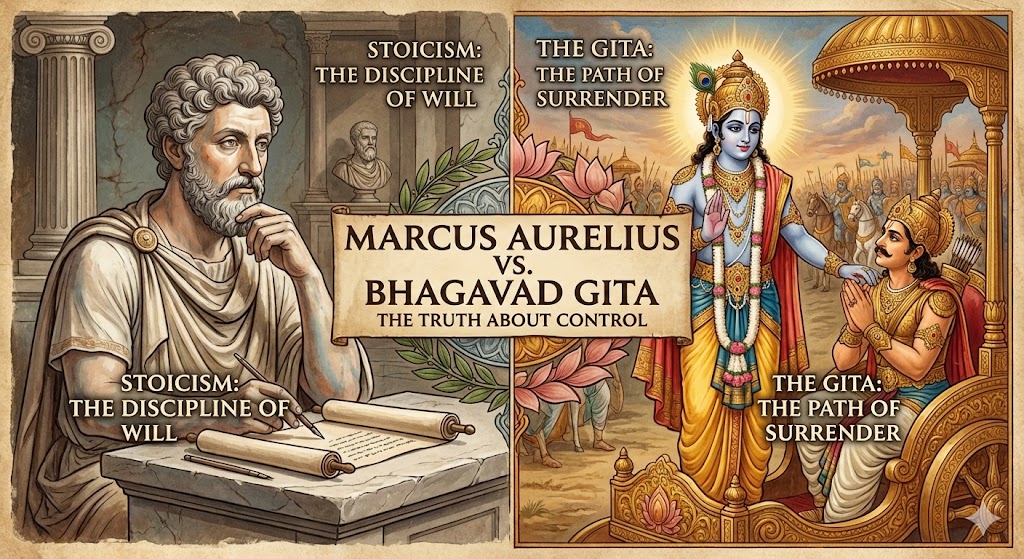
If you have spent any time looking for ways to improve your focus or productivity, you have likely stumbled upon Stoicism. In recent years, ancient Roman philosophy has become the ultimate mindset hack for modern professionals.
We are constantly told to adopt the “Stoic mindset”—to focus strictly on what we can control and ignore the rest. But what if this exact Western framework is secretly contributing to your burnout?
Today, we are looking at where Stoicism falls short, and how a 2,000-year-old concept from Indian philosophy offers the missing piece to the modern productivity puzzle.
The Stoic Limit: The Dichotomy of Control
Marcus Aurelius famously wrote in his Meditations: “You have power over your mind – not outside events. Realize this, and you will find strength.”
This is known as the Dichotomy of Control. It means dividing the world into two categories: your effort (which is up to you) and the outcome (which is not). The economy, the opinions of others, and the final results of your work are entirely out of your hands.
It sounds like perfect advice. But here is where the modern application of this Western mindset breaks down: What happens to your mental state when you do everything perfectly, you control your effort entirely, and you still fail?
For most high-achievers, treating effort as the only variable still ties their ego to the expectation of a reward. When the reward doesn’t come, it leads to deep emotional exhaustion and resentment.
The Eastern Antidote: Nishkama Karma
This is where the ancient wisdom of the Bhagavad Gita steps in to fill the gap left by Rome.
In Chapter 2, Verse 47, Lord Krishna imparts a profound truth to Arjuna: “Karmanye vadhikaraste Ma Phaleshu Kadachana.” (You have a right to perform your prescribed duty, but you are not entitled to the fruits of action).
This is the principle of Nishkama Karma—action without attachment.
Stoicism tells you to accept the outcome because you cannot control it. The Gita goes a massive step further: it tells you to renounce the outcome before you even begin. You do not just endure the result; you sever your ego from it entirely. You act because the action itself is your duty, your dharma, not because you are hungering for the success, the money, or the recognition it might bring.
Bridging the Two Frameworks
So, how do we apply this to modern life? We synthesize them.
- Use Marcus Aurelius for Discipline: Use the Stoic focus to build your daily routine. Put your head down and execute the tasks that are directly in front of you.
- Use the Bhagavad Gita for Peace: Protect your mind by renouncing the result. When you launch a project, sit for an exam, or build a business, execute with 100% intensity, but 0% attachment.
If it succeeds, great. If it fails, great. Your identity remains completely untouched.
True stability does not come from trying to control the world; it comes from acting boldly while remaining entirely unbothered by what the world gives back.
(Author’s Note: If you want to explore this concept further, watch my full video breakdown on the Lighted Sage YouTube channel here: [https://www.youtube.com/@KanhuOm-f8u])


